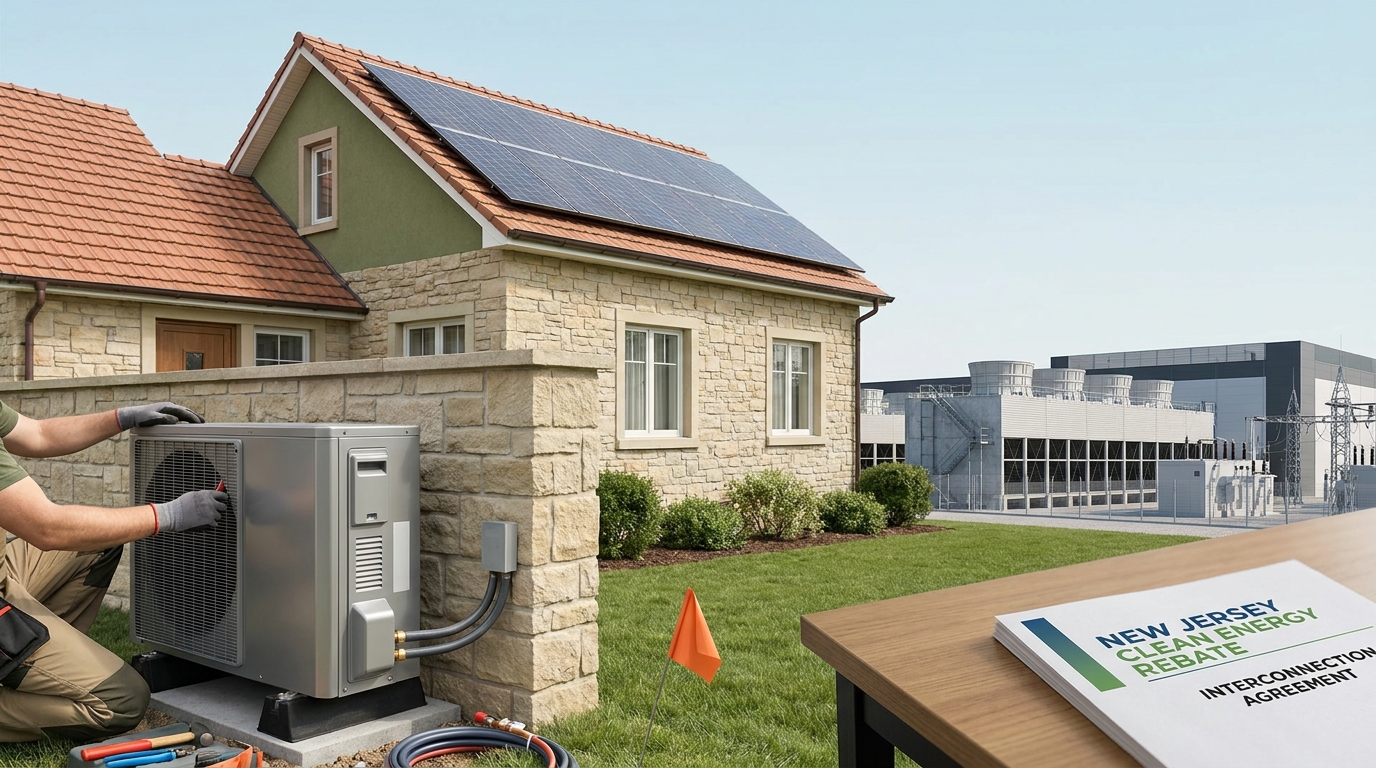
New Jersey regulators have established a novel framework allowing energy-intensive data centers to expedite grid interconnection queues by financing local residential energy retrofits. Under the policy enacted in July 2026, hyperscale developers looking to secure rapid capacity from regional transmission operators can offset their localized grid strain by deploying capital into targeted residential heat pump installations and envelope weatherization programs in surrounding service territories.
Offsetting Grid Constraints
The mechanism targets high-density corridors where grid congestion typically stalls industrial interconnections for years. Instead of waiting for utility substation rebuilds, commercial developers can directly subsidize clean heating conversions, effectively carving out peak distribution capacity. In territories served by Public Service Electric and Gas (PSE&G), shifting households from legacy oil or older gas systems to efficient cold-climate heat pumps reduces winter network constraints when paired with comprehensive envelope measures. For example, Edison 08820 currently sits in the WORTH A LOOK tier with an estimated 6.9-year payback; third-party capital from commercial developers could significantly reduce upfront capital burdens and shorten those return horizons.
Implementation and Oversight
The New Jersey Board of Public Utilities (BPU) will oversee the program's accounting mechanisms to ensure developer capital represents additionality rather than supplanting existing clean energy funds. While commercial operators benefit from shortened project lead times, regulators are tasked with verifying that modeled peak-load reductions from home electrification retrofits deliver verified capacity relief before granting expedited energization permits.