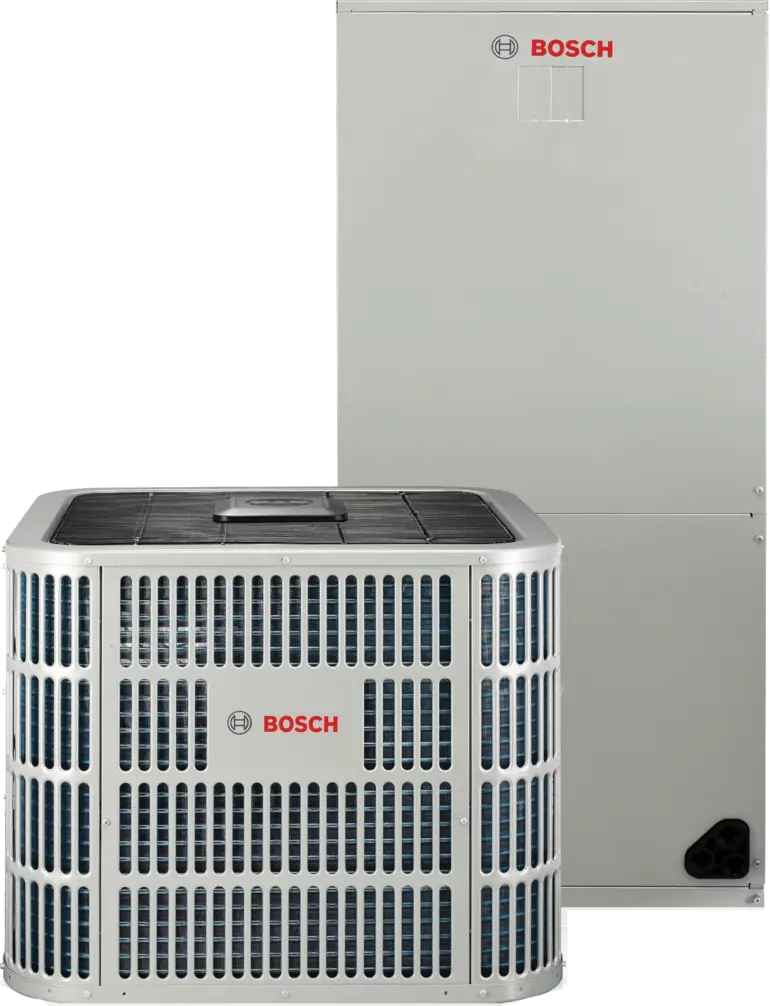
IDS 2.0 Premium (Inverter Ducted Split)
Summary
The Bosch IDS 2.0 Premium is a solid pick for homeowners looking to upgrade their existing ducted-central system, especially those replacing an aging gas furnace and AC. It shines in cold climates, boasting an HSPF2 of 9–10.5, making it very efficient at heating, even when temperatures drop. This unit is designed to drop into an existing plenum with minimal ductwork modification, simplifying retrofits. It's NEEP ccASHP certified, confirming its robust cold-climate performance down to -4°F. However, a key watch-out is its minimum modulated output. While it can modulate down to 25% of its capacity, this minimum may still be more than a very well-insulated 2000 sqft home needs during shoulder seasons or mild winter days, potentially leading to shorter cycles.
Who it's for
This unit is ideal for a 2,500 sqft suburban home in Climate Zone 5A, currently relying on an older 80% AFUE gas furnace and a SEER 12 AC. The IDS 2.0 Premium would provide a significant upgrade in both heating and cooling efficiency, leveraging existing ductwork to minimize installation costs and disruption while delivering substantial energy savings in a mixed-heating climate. Another good fit is a 3,000 sqft, multi-story house in Climate Zone 4, where the existing conventional AC is failing and the homeowner wants to move away from fossil fuels for heating. The Bosch IDS 2.0 Premium's capacity range of 2–5 tons ensures it can adequately heat and cool larger spaces, and its cold-climate certification means reliable performance through colder winters without heavy reliance on supplemental heat. Consider it for a 2,000 sqft ranch in Climate Zone 3A that's undergoing a deep energy retrofit. With improved insulation and air sealing, the home's heating load will decrease. The IDS 2.0 Premium's inverter technology allows it to modulate its output, matching the reduced load more precisely than a traditional single-stage system, providing consistent comfort and maximizing efficiency in a mild to moderate climate.
Real-world performance
The HSPF2 of 9–10.5 and SEER2 of 18–20.5 for the Bosch IDS 2.0 Premium translate directly into significant energy savings for homeowners. In Climate Zones 3A to 6, where this unit is rated, you can expect to cut your annual heating and cooling energy use by 30-50% compared to a baseline 90% AFUE gas furnace and SEER 14 AC. For instance, in a Zone 5 home, this could mean reducing your heating bill by hundreds of dollars annually, depending on electricity rates and natural gas prices. Its NEEP ccASHP certification and minimum operating temperature of -4°F mean it delivers substantial heat output even in very cold conditions. You'll find it maintains comfortable indoor temperatures without needing to kick into auxiliary heat until well below freezing. While it can operate down to -4°F, its efficiency will naturally decrease at the extreme end of its range. For consistent comfort and efficiency in the coldest stretches of Zone 6, a small amount of supplemental electric resistance heat might still be needed on the very coldest days, but its primary heating capacity is robust. The inverter drive ensures consistent, quiet comfort without temperature swings.
Installation notes
Installing the Bosch IDS 2.0 Premium typically involves integrating the indoor air handler with your existing ductwork. Since it's a ducted-central system, the main considerations revolve around the plenum connection and ensuring adequate static pressure for optimal airflow. Most existing plenums can accommodate this unit, but a qualified installer will verify duct sizing and integrity. Unlike ductless systems, indoor head placement isn't a concern, but the outdoor unit requires standard clearances for airflow—typically 12-24 inches from walls or other obstructions. Line-set lengths are generally flexible, but excessively long runs can impact performance; your installer will calculate the optimal length and refrigerant charge. Permit expectations are standard for any HVAC replacement: expect local building permits for electrical and mechanical work. First-time heat pump buyers might be surprised by the electrical service requirements; while efficient, these units still need a dedicated circuit, and older homes might require an electrical panel upgrade. Ensure your installer is familiar with heat pump-specific regulations and local codes to avoid delays or issues during inspection.
Maintenance & warranty
Annual maintenance for the Bosch IDS 2.0 Premium is straightforward, typically costing $150-$300. This includes cleaning the outdoor coil, checking refrigerant levels, inspecting electrical connections, and ensuring proper drainage. For ducted systems, regular filter changes are crucial—every 1-3 months depending on usage and household conditions—to maintain airflow and efficiency. Coil cleaning, especially the indoor evaporator coil, might be needed every few years, depending on air quality. A refrigerant leak can significantly reduce performance and damage the compressor; indicators include reduced heating/cooling, ice formation on the outdoor unit, or unusual noises. Promptly address any suspected leaks. The standard warranty typically includes 10 years on parts, provided the unit is registered within a specified timeframe (often 60-90 days) by a licensed installer. What voids the warranty? Failing to register the unit, having it installed by an unlicensed contractor, or neglecting annual professional maintenance are common traps. Always keep records of your annual service appointments, as these may be required to validate a warranty claim.
Common complaints
Owners of the Bosch IDS 2.0 Premium generally appreciate its quiet operation and consistent comfort. However, some common complaints do surface. A few users have noted that the defrost cycle, while necessary, can be noticeable, sometimes producing steam or a slight hum from the outdoor unit, especially in very cold, humid conditions. While this is normal heat pump behavior, it can be a surprise for those accustomed to traditional furnaces. Dealer responsiveness and installation quality are also frequently cited, not necessarily as a flaw of the unit itself, but as a critical factor in overall satisfaction. As with any complex HVAC system, a poor installation can lead to performance issues that are then misattributed to the equipment. Finally, some homeowners, particularly those in milder climates, occasionally mention that the minimum modulated capacity, while low, can still be slightly oversized for extremely well-insulated homes, potentially leading to shorter run times than ideal for maximum efficiency.
Price context
The typical installed price for the Bosch IDS 2.0 Premium, ranging from $6,500 to $11,500, positions it as a mid-to-high-range option within the ducted heat pump market. This is generally competitive with other inverter-driven ducted systems like the Mitsubishi Hyper-Heat or Carrier Greenspeed, which often fall into a similar price bracket. It's usually more expensive than a basic single-stage heat pump but offers superior efficiency and comfort. The federal IRA §25C tax credit can cover 30% of the installed cost, up to $2,000, for this NEEP ccASHP-certified unit, significantly reducing the out-of-pocket expense. While the Bosch IDS 2.0 Premium is a premium product, it is often included in state and local income-qualified HEEHRA programs, making it accessible to a broader range of homeowners, assuming it meets specific program criteria for efficiency and cost-effectiveness.
FAQ
- How does the Bosch IDS 2.0 Premium perform in extreme cold compared to a gas furnace?
- The Bosch IDS 2.0 Premium is NEEP ccASHP certified and operates down to -4°F, delivering significant heat output. While a gas furnace maintains full heating capacity regardless of outside temperature, the heat pump's efficiency decreases as temperatures drop. However, with an HSPF2 of 9–10.5, this unit will still be far more efficient than electric resistance heat and often more cost-effective than natural gas in many regions, even in colder weather. It's designed to minimize the use of auxiliary heat.
- Can the Bosch IDS 2.0 Premium integrate with my existing smart thermostat?
- Yes, the Bosch IDS 2.0 Premium is generally compatible with most standard 24V smart thermostats, including popular brands like Ecobee or Nest. Its inverter technology allows for precise temperature control, which pairs well with advanced thermostat features. Your HVAC installer will ensure proper wiring and configuration to maximize the benefits of both the heat pump and the smart thermostat, allowing for remote control and optimized scheduling.
- What is the difference between SEER2 and HSPF2, and why are these important for the Bosch IDS 2.0 Premium?
- SEER2 (Seasonal Energy Efficiency Ratio 2) measures cooling efficiency, while HSPF2 (Heating Seasonal Performance Factor 2) measures heating efficiency. Both are updated metrics (since 2023) reflecting real-world performance more accurately. For the Bosch IDS 2.0 Premium, its SEER2 of 18–20.5 and HSPF2 of 9–10.5 indicate very high efficiency for both cooling and heating, meaning lower electricity consumption and operating costs compared to less efficient units. These numbers are key indicators of its energy-saving potential.
- Is the refrigerant R410A in the Bosch IDS 2.0 Premium being phased out?
- Yes, R410A is being phased down under EPA regulations due to its high Global Warming Potential. While new R410A equipment can still be manufactured and sold for several years, the industry is transitioning to lower-GWP refrigerants like R454B. Units like the Bosch IDS 2.0 Premium using R410A are still perfectly legal to install and service, and R410A will remain available for servicing existing equipment for the foreseeable future. This unit is a current, viable option.
Often compared with
- Carrier Greenspeed
- Mitsubishi Hyper-Heat (Ducted)
- Trane XV19/XV20i