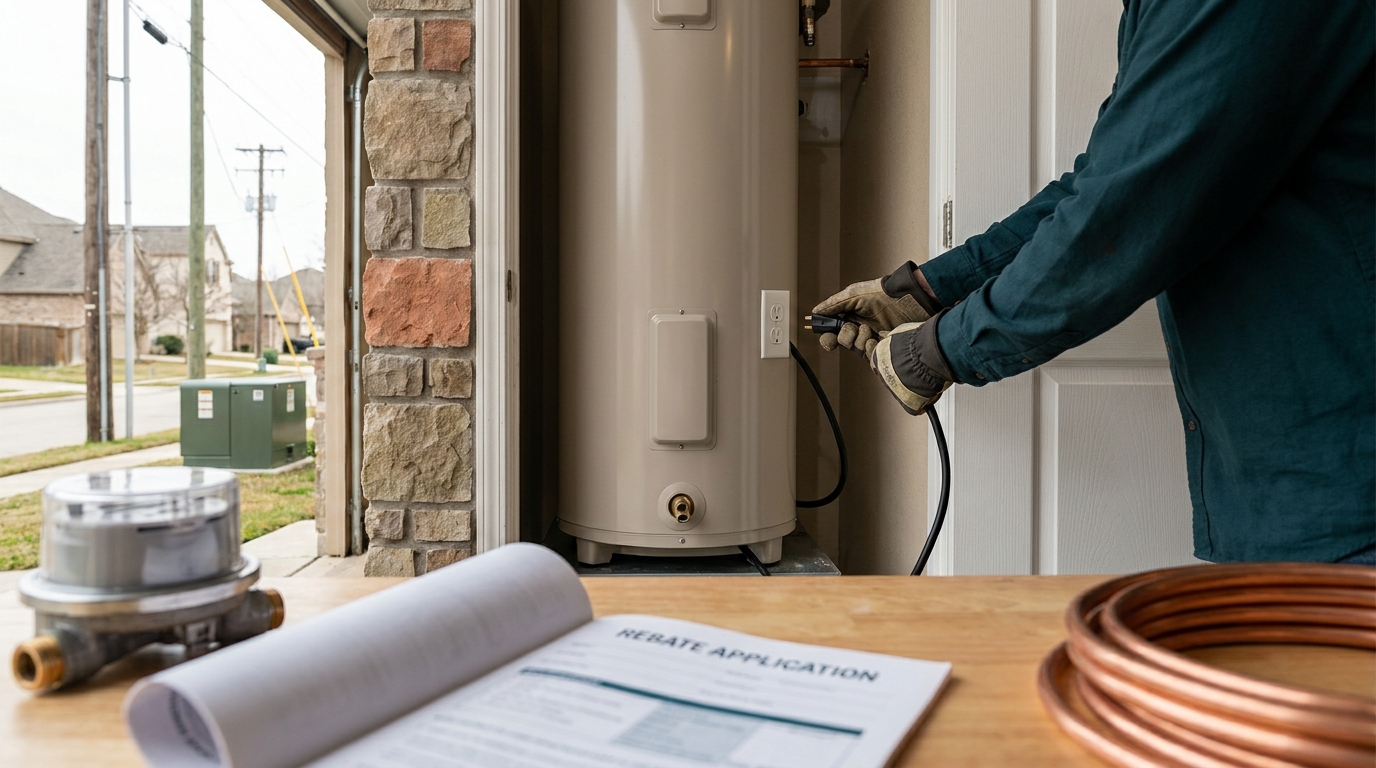
Residential water heating accounts for roughly 18% of typical home energy use, making it the second-largest utility expense after space conditioning. While dedicated 240-volt heat pump water heaters (HPWH) deliver Uniform Energy Factor (UEF) ratings above 3.5, adoption has frequently stalled at the electrical panel. Converting from an atmospheric gas water heater typically requires running a new 30-amp, 240-volt circuit. For homes with older 100-amp service, this often triggers a full panel replacement costing between $2,000 and $5,000 before the appliance is even purchased.
Bypassing Electrical Upgrades
The market entry of 120-volt plug-in heat pump water heaters directly addresses this bottleneck. These units operate on standard 15-amp or 20-amp shared or dedicated 120-volt circuits, allowing installers to swap out gas water heaters without adding high-voltage wiring. To compensate for the lower instantaneous heating capacity of standard 120V power, manufacturers utilize optimized compressor controls, advanced thermal mixing valves, and integrated backup strategies that store water at higher temperatures to extend effective output during peak demand events.
Federal incentives under the Inflation Reduction Act Section 25C provide a 30% tax credit up to $2,000 for qualified HPWH installations, substantially altering the financial math. When paired with state and utility rebates, upfront equipment premiums over standard electric-resistance or gas units diminish rapidly. In high-electricity-cost markets like Boston, MA (02101), where Eversource delivers supply, standard retrofits already register a SOLID YES on the HeatPumpScore index with an estimated 3.5-year payback; eliminating dedicated circuit costs further stabilizes those returns.
While 120V models offer simpler installation paths, system sizing requires careful modeling. Recovery rates are inherently slower than 240V hybrid systems that use dual 4,500-watt resistance elements. Households with high concurrent hot-water usage may require larger storage volumes, such as 66-gallon or 80-gallon tanks, to maintain service levels without relying on continuous high-draw recovery.