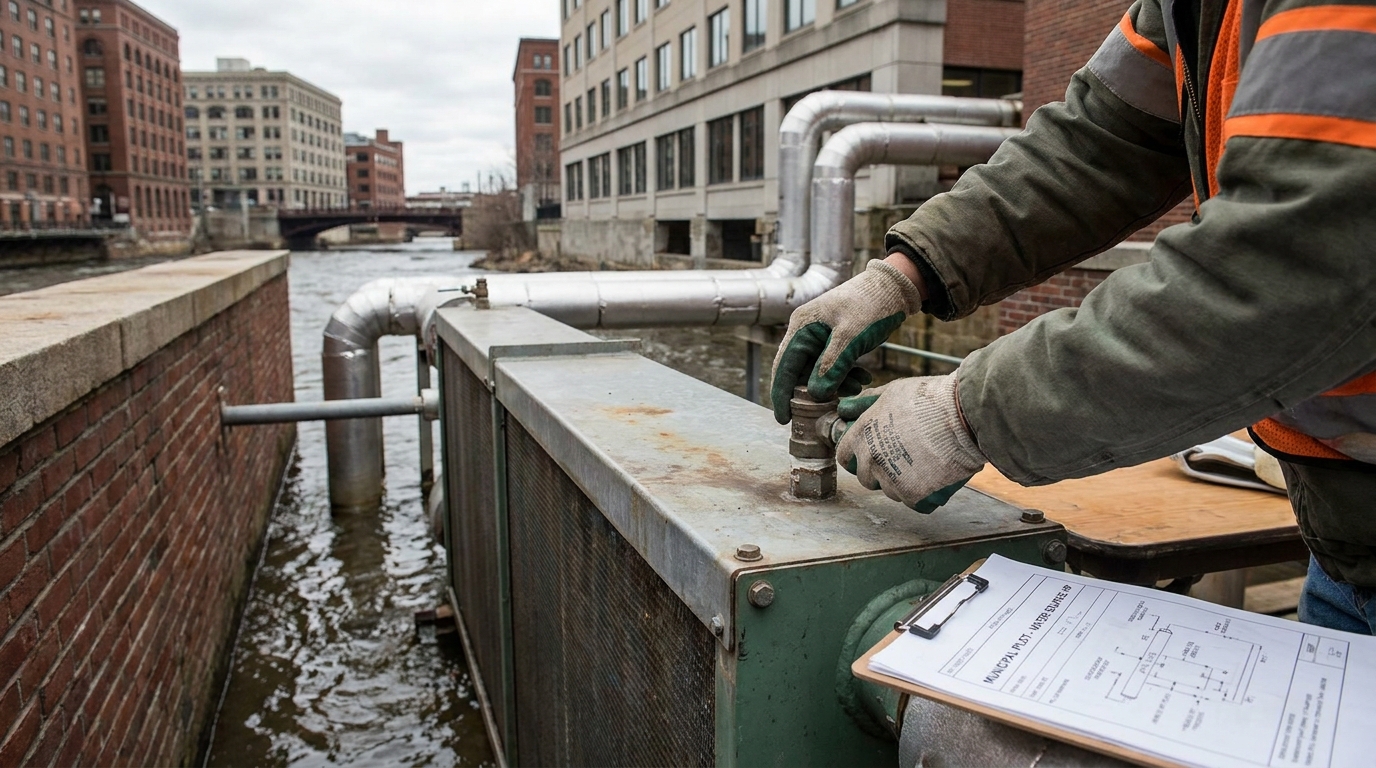
Municipal planners in Boston and Cambridge are studying surface water heat-pump networks to heat and cool large commercial and residential buildings. By exchanging thermal energy with Boston Harbor and the Charles River, these planned district energy systems aim to bypass the physical constraints of dense urban centers, where traditional vertical borehole fields for ground-source geothermal are rarely feasible due to underground utility congestion.
The initiative focuses on large-scale applications where individual air-source systems struggle with roof space constraints and electrical service capacity. Under early pilot frameworks, centralized heat exchanger stations pump water through closed loops, extracting heat during winter and rejecting thermal loads in summer. Water-source systems can achieve coefficients of performance above 4.0, significantly higher than typical air-source units during sub-freezing New England cold snaps.
District Thermal Economics and Grid Impact
For building operators, moving to water-source district thermal alters the operational math. In downtown Boston (ZIP 02101), residential conversions already sit in the SOLID YES tier with an estimated 3.5-year payback, aided by Eversource electric rates and Mass Save incentives. However, commercial high-rises face distinct capital expenditure hurdles. District water loops distribute thermal capacity across multiple properties, reducing the peak electrical demand that individual building-level heat pumps would otherwise draw from the local grid.
State and municipal regulators are currently reviewing environmental considerations, including local water temperature changes and aquatic ecosystem protections. If permitting and feasibility studies proceed as modeled, developers could integrate water-source loops into major waterfront redevelopments over the coming decade, creating a template for other dense coastal and riverfront cities.