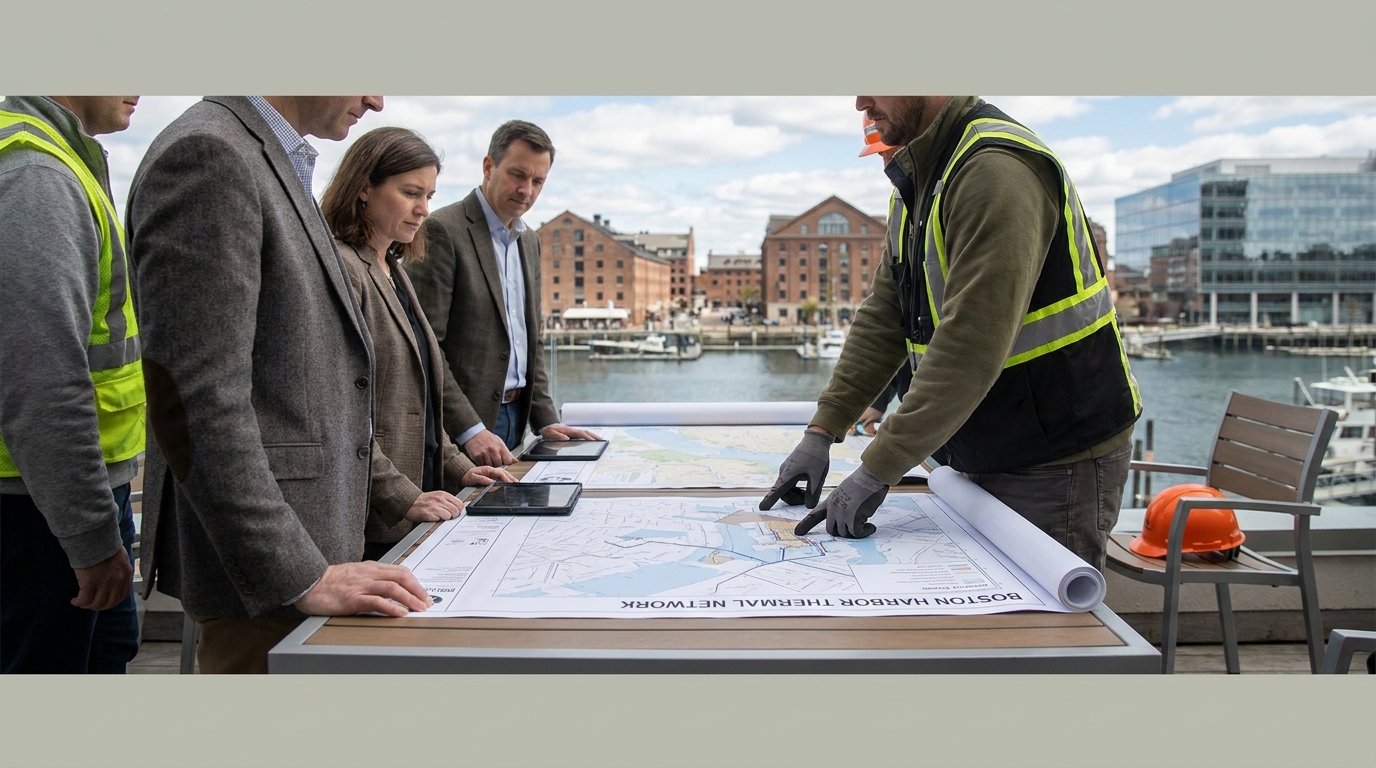
Municipal planners, researchers, and local utilities in Boston are evaluating surface-water heat pump systems to decarbonize dense urban clusters. By drawing thermal energy from Boston Harbor and the Charles River, these networked district energy pilots aim to bypass space constraints that often limit conventional ground-source geothermal boreholes in urban cores. Water-source heat pumps use ambient water bodies as thermal sinks and sources, circulating water through closed or open loops to central heat exchange facilities.
Urban Thermal Constraints
Dense metropolitan areas face structural barriers to standard electrification. High-rise commercial properties and multi-unit residential complexes typically lack the land area required for vertical borehole fields, while air-source systems can face capacity and aesthetic constraints on crowded rooftops. Massachusetts state climate mandates require substantial emission reductions by 2030, putting pressure on utilities like Eversource and National Grid to explore networked geothermal and ambient-water pilots. For existing properties, individual parcel economics remain strong: Boston 02101 already scores a SOLID YES on the HeatPumpScore index (72/100, 3.5-year estimated payback under Eversource), but shared water-source infrastructure could extend comparable efficiencies to large master-metered buildings.
Engineering and Permitting Realities
While water-source district heat pumps operate reliably across northern Europe, deploying them in domestic urban waterways introduces specific engineering hurdles. Systems must account for seasonal water temperature fluctuations, biofouling from marine organisms, and strict environmental permitting limits on thermal discharge to protect aquatic ecosystems. State regulators must review temperature differentials to ensure discharged water does not disrupt local habitats during peak summer cooling or winter heating cycles.
The Boston study remains exploratory, focusing on capital expenditure requirements, energy transfer coefficients, and potential interconnections with Mass Save commercial incentive pathways. If feasible, these surface-water thermal networks could serve as a shared utility asset, spreading upfront capital costs across multiple commercial and residential accounts.